
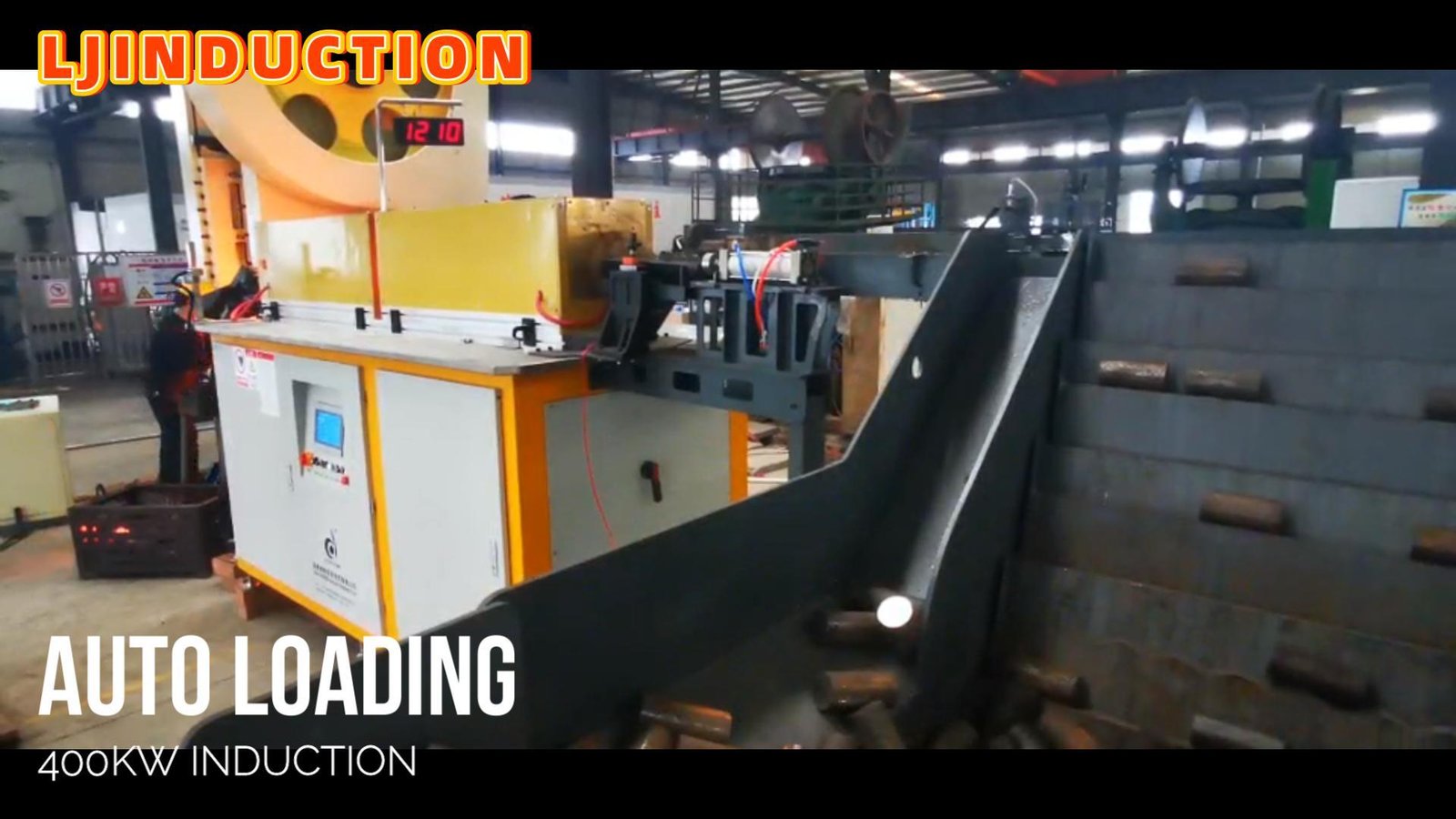
Efficient, precise, and energy-saving induction heating solutions for billets in forging and metal processing industries.
A complete induction heating solution for metal billets, delivering fast, uniform, and controllable heating for forging, extrusion, rolling, and hot forming applications.
An induction billet heating machine is a specialized system for fast, uniform, and controllable heating of metal billets before forging, extrusion, rolling, and other hot forming processes.
How it works
Alternating current passes through the induction coil
The coil generates a magnetic field
The billet produces eddy currents and heats up directly
Heating area and temperature can be controlled more precisely than with traditional furnace heating
Typical processes
Billet forging
Heat treatment
Preheating before forging
Sectional heating
Whole heating
Why induction heating suits billets
Billets are often large and require stable heating quality
Faster heating than traditional furnaces
Better temperature uniformity
Easier automation and line integration
Typical billet types
Steel billets
Aluminum billets
Copper billets
Alloy billets
Titanium billets
Supported billet structures
Solid billets
Hollow billets
Long billets
Stepped billets
Round billets
Square billets
Other supported bar or bloom formats
Applicable materials
Carbon steel
Alloy steel
Stainless steel
Other forgeable metals
Selected non-ferrous billets if supported
Custom design for your billet process
The final system is selected according to billet material, section size, length, heating target, and production rate. Different billets require different power, frequency, coil design, and handling methods.
With the Shaft Forging Induction Heating System, you will experience faster processing times and reduced energy costs.
| Parameter (CN / EN) | Specification / Value |
|---|---|
| General / 基本信息 | |
| Product Name / 产品名称 | Induction Billet Heating Machines |
| Model / 型号 | Custom, based on billet application and production requirements |
| Applications / 应用类别 | Forging, extrusion, rolling, hot forming, preheating and related metal processing |
| Operating Principle / 工作原理 | Electromagnetic induction heating for round, square, solid, hollow, and other supported billets |
| Workpiece Compatibility / 工件适配范围 | |
| Billet Materials / 适用坯料材料 | Carbon steel, alloy steel, stainless steel, and selected non-ferrous billets if supported |
| Billet Shapes / 适用坯料形状 | Round billets, square billets, bars, blooms, and other supported formats |
| Billet Size Range / 适用坯料尺寸范围 | Selected according to billet diameter / section size, billet length, and billet weight |
| Key Process Parameters / 关键工艺参数 | |
| Billet Diameter / Section Size / 坯料直径或截面尺寸 | Customized according to actual billet process |
| Billet Length / 坯料长度 | Customized according to heating method and handling layout |
| Billet Weight / 坯料重量 | Matched to system power, coil design, and throughput target |
| Heating Temperature Range / 加热温度范围 | Determined by billet material and required forming process |
| Heating Time / 加热时间 | Depends on billet material, section size, target temperature, and output requirement |
| Dwell / Soak Time / 保温时间 | Configured according to process requirement if needed |
| Throughput / Production Rate / 产能 | Designed according to line pace and billet handling method |
| Electrical & Output / 电气与输出 | |
| Input Voltage / 输入电压 | 380V / 415V / 440V, 3-phase, customizable according to local power supply |
| Power Range / 功率范围 | Selected according to billet material, billet size, and production rate |
| Frequency Range / 频率范围 | Matched to required heating depth and billet section size |
| Output Configuration / 输出配置 | Customized according to heating process and system architecture |
| Auto-Tuning / 自动调谐 | Available |
| Control & Monitoring / 控制与监测 | |
| Control Mode / 控制方式 | PLC-based control with recipe management |
| Temperature Control / 温度控制 | Closed-loop control with infrared temperature feedback |
| Temperature Control Accuracy / 温控精度 | Depends on sensor arrangement, billet type, and process setup |
| Data Logging / 数据记录 | Optional real-time recording for temperature, cycle time, and energy use |
| Coils & System Configuration / 线圈与系统配置 | |
| Coil Design / 线圈设计 | Customized according to billet shape, material, and heating target |
| Supported Heating Layouts / 支持加热布局 | Single-station, multi-station, progressive, step-feed, or other customized layouts |
| Loading / Unloading / 上下料方式 | Manual, semi-automatic, or fully automatic integration |
| Cooling Requirements / 冷却要求 | |
| Cooling Method / 冷却方式 | Water cooling system or chiller |
| Cooling Capacity / 冷却能力 | Selected according to power level, coil design, and operating duty |
| Water Quality & Flow / 水质与流量要求 | Specified according to final system design |
| Safety & Protection / 安全与保护 | |
| Electrical Protection / 电气保护 | Overcurrent, overvoltage, overheating, and cooling interlocks available |
| Safety Functions / 安全功能 | Alarm system and protection logic configured according to project requirements |
Our induction billet heating machines are designed to provide:
Fast heating to the required forming temperature
Uniform billet heating across the length and section
Stable temperature consistency from surface to core
Reliable performance for forging, extrusion, and hot forming lines
How uniform heating is achieved
Multi-zone heating for long billets
Optimized coil design for uniform temperature distribution
Advanced temperature feedback and control systems
Process tuning matched to billet size, shape, and material
Typical heating problems this helps reduce
Low temperature at billet ends
Overheating at stepped sections
Surface overheating before the core reaches target temperature
Temperature instability between billets or batches
Why coil design matters
Directly affects heating speed
Directly affects energy efficiency
Directly affects temperature uniformity
Must be matched to billet material, size, and shape
Common coil types
Encircling coil
Multi-turn coil
Single-shot heating coil
How coil design is matched to billets
Long billets: scan heating or multi-zone heating for better temperature consistency
Stepped billets: tailored design to reduce local overheating
Hollow billets: matched according to wall thickness and heating depth
Fast changeover advantage
Coil replacement can be completed in as fast as 15 minutes
Helps reduce downtime between billet size changes
Improves flexibility for multi-product production
Standard system components
Induction power supply
Induction coil
Cooling system
Control panel
Temperature monitoring system
Automatic or manual loading systems
Available configuration options
Single-station or multi-station heating
Fully automated or semi-automated solutions
Integration with existing forging presses
Integration with conveyor systems
Compatibility with feeders, sensors, and control software
Can be integrated with
Available automation levels
Suitable for upgrade projects
Quality benefits
Better temperature repeatability
Reduced scale formation
Lower risk of decarburization
More consistent forging conditions
Better preparation for downstream heat treatment
Metallurgical value
More uniform microstructure
Better hardness consistency after downstream treatment
Lower risk of local overheating
Reduced distortion risk caused by uneven heating
Typical problems this helps reduce
Cracks from improper heating
Soft spots at transitions
Non-uniform hardness
Thermal damage on shoulders
Excessive oxidation and material loss
Customer-facing results
Better forging consistency
More stable dimensions after forging
Reduced scrap and rework
Compared with traditional gas- or oil-fired furnaces, induction billet heating offers:
Potential production benefits
Forging Shops
Pre-forging heating of steel billets and bars before presses or hammers.
Typical needs: fast heating cycles, stable billet temperature, better throughput matching.
Extrusion Plants
Billet heating before extrusion for more controlled forming conditions.
Typical needs: uniform billet temperature, repeatable cycle time, easier automation.
Rolling Mills
Preheating billets for rolling and continuous hot processing lines.
Typical needs: line synchronization, high output stability, efficient integration.
Automotive Component Manufacturing
Heating billets for crankshafts, gears, bushings, and engine-related parts.
Typical needs: tight temperature tolerance, high throughput, compact automated layouts.
Aerospace Precision Forging
Heating specialty alloy billets for high-precision forged components.
Typical needs: traceability, uniform heating, qualification support, long-term reliability.
Oil & Gas / Heavy Industry / Shipbuilding
Heating billets for valves, drill bits, shafts, and structural forged parts.
Typical needs: robust equipment, low downtime, lifecycle cost control, service support.
Non-Ferrous Billet Processing
Heating aluminum, copper, and other supported billets for extrusion or forming.
Typical needs: flexible coil design, scalable investment, easy maintenance.
In addition, our Shaft Forging Induction Heating System can be tailored to meet specific industry requirements, enhancing flexibility.
An induction billet heating machine should be sized according to the real billet process, not chosen as a standard machine. Different billet materials, sizes, temperatures, and output targets require different power, frequency, coil design, and line configuration.
To recommend the right solution, we usually evaluate billet material, billet shape and size, billet length, target temperature, heating time, throughput, and automation requirement. If the system needs to connect with an existing line, we also consider the current feeding, handling, and control setup.
Based on this information, we can recommend a suitable heating solution, including power and frequency selection, coil design concept, heating layout, and automation configuration. This helps ensure the system is matched to the actual billet heating process instead of being selected only by rough estimates.
Explore high-efficiency medium-frequency induction heating machines (1–20 kHz) for precise heat treatment, forging, and metal processing.
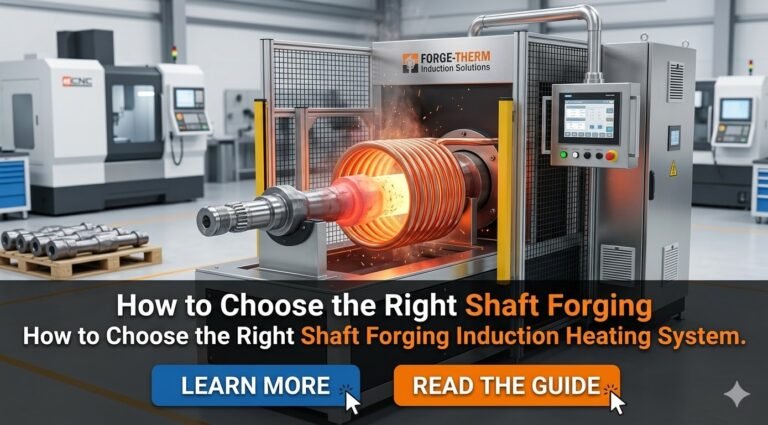
Discover how to choose the right shaft forging induction heating system for your shaft size, material, heating length, output, and automation needs.